title: Insoles for Flat Feet: Arch Support That Works meta: The best insoles for flat feet: firm arch support insoles vs orthotics, top brands like PowerStep and Superfeet, and how to pick support that actually helps fallen arches.
Insoles for Flat Feet: Arch Support That Works
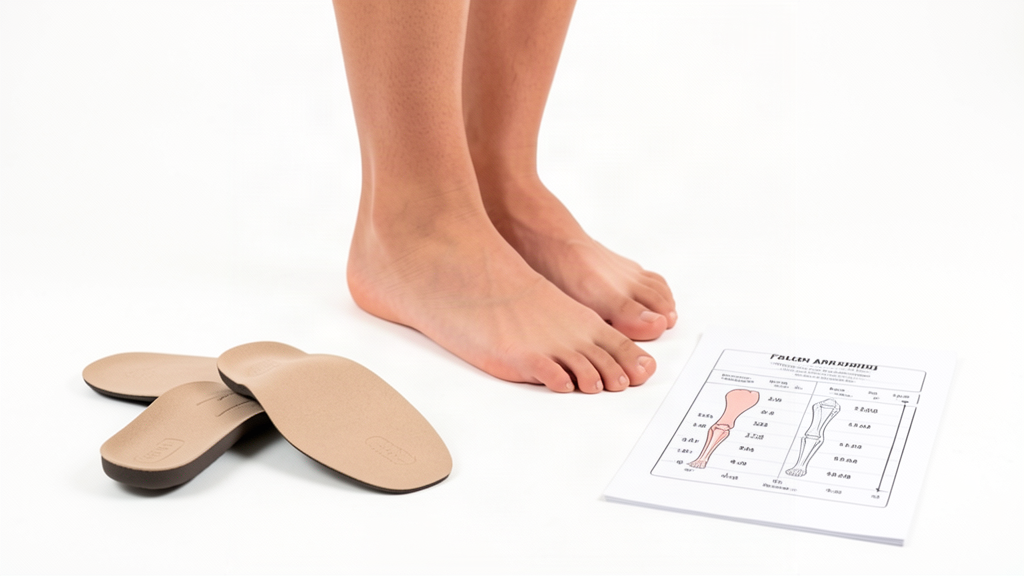
Flat feet turn every hard floor into a negotiation. Without a natural arch to distribute impact, your foot rolls inward with each step, and the ache can run from the arch itself up through the ankle and knee. The right insoles for flat feet fill the gap your arch doesn't — supporting it so the foot works the way it's designed to.
This guide explains what actually helps fallen arches, which arch support insoles are worth buying (and which are marketing fluff), and how to choose between off-the-shelf and orthotics for plantar support. It's for anyone whose feet flatten, ache, or tire easily — and who's tired of guessing which insole to buy.
This article is for informational purposes only and is not medical advice. Talk to your doctor or podiatrist about persistent foot pain.
(As an Amazon Associate we earn from qualifying purchases. We may also earn commissions from brands listed.)
The Problem Explained: What Flat Feet Actually Do to Your Body
A "normal" arch is a spring: it flattens slightly on impact, absorbs shock, and snaps back at push-off. A flat foot (pes planus) starts collapsed — the whole sole makes contact, and the spring becomes a slab. Two things follow:
- Impact travels up the chain. Without the arch's shock absorption, force moves into the ankle, knee, and hip. This is why many flat-footed people don't just have foot pain — they have "everything above the foot" pain.
- Overpronation compounds it. The flattened arch lets the ankle roll inward with each step, twisting the lower leg and straining soft tissue repeatedly. Overpronation, not flatness itself, is usually what hurts.
Not all flat feet hurt, and not all aching flat feet need the same fix. Flexible flat feet (arch present when sitting, gone when standing) respond well to support; rigid flat feet may need professional care. Orthotics for plantar strain work by supporting the arch where it collapses during standing and walking.
How Arch Support Insoles Actually Help
An insole can't rebuild your arch — nothing off a store shelf can. What good arch support insoles do is subtler:
- Fill the collapsed space. A firm post under the arch stops the foot from sagging fully, keeping the subtalar joint closer to neutral.
- Slow the inward roll. By supporting the medial (big-toe-side) edge, a structured insole reduces how far the foot pronates each step.
- Redistribute pressure. Spreading load across the whole sole stops hot spots under the ball and heel.
- Cut fatigue. Less collapse means the small foot muscles work less to stabilize every step — many users report noticeably less end-of-day tiredness.
Honesty check: support should feel firm but comfortable within a week or two. If an insole causes sharp pain or fits like a ridge under your arch, it's the wrong shape — not a "tough adjustment period."
Top Insole Options for Flat Feet by Use Case
Here are the options that genuinely fit flat feet, based on our research into materials, geometry, sizing, and owner reviews:
| Use case | Top pick | Price (at publish) | Why it works for flat feet |
|---|---|---|---|
| Everyday all-purpose | PowerStep Pinnacle | ~$50 | Moderate firm arch + deep heel cup, neutral support |
| Maximum stability | Superfeet Green | ~$55 | High, very firm fill — but only if it fits your arch shape |
| Work boots / standing | Timberland PRO Anti-Fatigue | ~$40 | Cone-shaped shock absorption under full sole |
| Sport / running | PowerStep Pulse or Superfeet Berry | ~$50 | Firm support in performance shape |
| Budget trial | Dr. Scholl's Extra Support | ~$20 | Cheap entry to test if support helps you |
| Dress shoes | PowerStep SlimTech 3/4 | ~$40 | Low-profile support for shallow shoes |
For deep dives on specific models, read the best insoles for plantar fasciitis — several of those picks (Pinnacle, Superfeet) double as the strongest flat-feet options, since plantar support and arch fill overlap heavily.
Quick notes on each
- PowerStep Pinnacle — the default recommendation: a semi-rigid shell with a moderate arch that most flat feet tolerate well. The best balance of support and comfort for fallen arches.
- Superfeet Green — the firmest fill in the mainstream market. Excellent for high-volume shoes; some flat feet find the tall ridge painful — Superfeet offers lower-profile alternatives (Blue, Orange) if Green is too much.
- Timberland PRO Anti-Fatigue — technically a work-insole, its cone-geometry padding supports standing labor where flat feet suffer most.
- Dr. Scholl's Extra Support — a $20 sanity check: if support helps at all, this proves it before you spend $50+.
How to Choose Flat-Feet Insoles (Decision Table)
| Question | Look for | Avoid |
|---|---|---|
| How collapsed is your arch? | Fully flat → moderate-height firm fill | Rigid tall posts that bruise the arch |
| Flexible or rigid flat foot? | Flexible → OTC support works well | Rigid/painful → see a podiatrist first |
| What shoes will wear them? | Roomy shoes → full-length; dress → 3/4 length | Forcing thick insoles into slim shoes |
| Standing all day? | Cushioned top layer + firm base | Pure firm shells with no comfort layer |
| First time buying insoles? | Start ≤$50 with returns | $80+ alignment wedges as a first try |
Fit and Sizing Rules
- Remove the factory insole before inserting a full-length replacement, or the stack crowds your toes.
- Trim conservatively. You can trim more; you can't add back. Trim against your shoe's original insole as a template.
- Check volume. If your heel slips or the top of the shoe presses, the insole is too thick for that shoe.
- Break in over 1–2 weeks. An hour the first day, then add an hour daily. Mild arch awareness is normal; sharp pain is not.
When to See a Podiatrist Instead
Off-the-shelf insoles are a great first move for flexible, aching flat feet. But professional help is the right call when: pain is sharp or worsening; one foot flattens but the other doesn't (adult-acquired flatfoot is a tendon problem); your ankle tilts visibly outward; or OTC insoles haven't helped after 4–6 honest weeks. Custom orthotics and physical therapy do things no shelf product can.
Pairing insoles with the right shoes multiplies the effect — see the best shoes for plantar fasciitis and the best shoes for flat feet. For tape-based arch support during sports, our KT tape application guide covers a useful technique, and the best sole inserts rounds out the insert lineup.
FAQ
Can insoles fix flat feet? No — and be wary of any product that claims to. Flat feet are a structural shape, and adults don't grow new arches from wearing insoles. What good insoles do is support the collapsed arch during standing and walking, which may reduce the strain, fatigue, and pain that come with it. Many users report significant comfort improvements despite the shape staying the same.
What's the difference between arch support insoles and orthotics? "Arch support insoles" usually means prefabricated inserts bought off a shelf in general sizes. "Orthotics" technically means custom-made devices from a podiatrist built from casts or scans of your feet, though the word gets used loosely in marketing. Custom orthotics cost more ($200–$600 typically) and matter most for complex cases; quality prefabs serve most people well.
Are firm or soft insoles better for flat feet? Firm, with a comfortable top layer. Soft gel squishes flat under body weight and provides almost no support within minutes — the collapse continues right through it. Flat feet need structure that resists compression, paired with a thin cushioned surface for comfort.
How long does it take to get used to new insoles? Most people adjust within one to two weeks of gradually increasing wear time. Start with an hour a day and add an hour daily. Sharp pain, numbness, or new pain in the knee or hip means the shape is wrong for you — stop and reassess.
Should children with flat feet wear insoles? See a pediatric podiatrist rather than self-treating. Many children's arches develop naturally through early childhood, and flat arches in young kids are often normal. Professional evaluation distinguishes normal development from a problem worth supporting.
Do flat feet get worse with age? They can. The posterior tibial tendon that supports the arch can weaken with age, weight gain, or injury, letting a previously OK arch flatten further — a condition called adult-acquired flatfoot. Staying at a healthy weight, wearing supportive shoes, and addressing pain early all help keep adult arches functioning.
Comments