Foot Massage Spas Near Me vs At-Home: Costs Compared
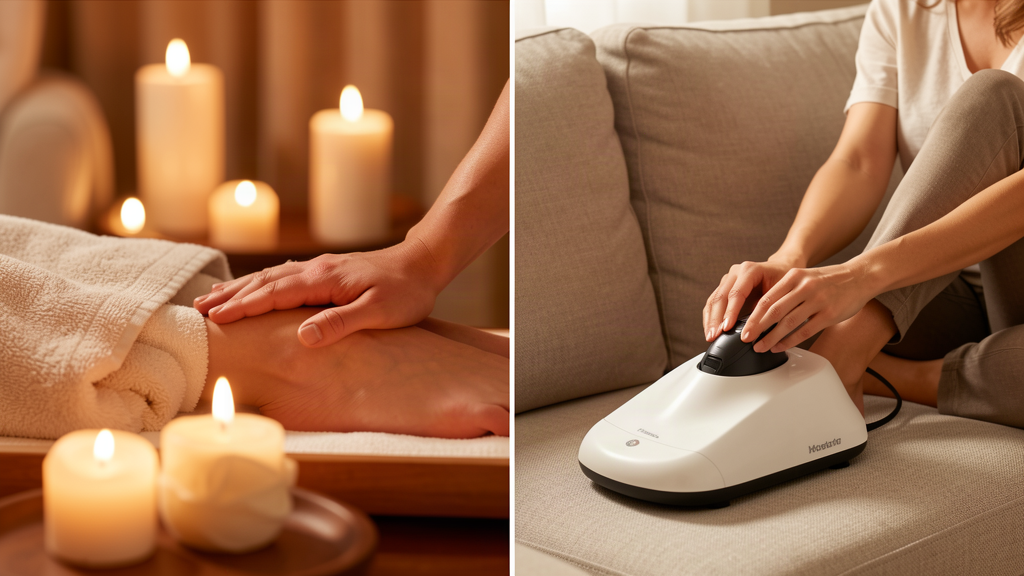
The monthly ritual: you type "foot massage near me," see the $40–60 price tags, feel the reflexive "that's a lot" flinch — and then glance at the $150 foot massager gathering dust-or-glory in your living room and wonder which one is the smarter play. The honest answer: for pure per-dollar relief, a good home machine wins within weeks. For therapeutic skill and full-body de-stressing, a good human wins — and nothing with a plug replicates it.
This guide puts real 2026 numbers on both sides: what spa visits actually cost per session (including tip and hidden extras), what home machines cost per session at various ownership durations, where each option genuinely performs better, and how to build the hybrid routine that gets the best of both.
(As an Amazon Associate we earn from qualifying purchases. We may also earn commissions from brands listed.)
Quick Verdict: Who Wins What
| Category | Spa Visit | At-Home Massager | Winner |
|---|---|---|---|
| Per-session cost (first 3 months) | $40–75 | $1.25–$4 | Home |
| Per-session cost (long-run, 2 yrs) | $40–75 | $0.15–$0.75 | Home |
| Deep, skilled, adaptive pressure | Yes | No — fixed programs | Spa |
| Anatomical problem-solving | Trained hands find knots | Machines follow programs | **Spa |
| Convenience (11 p.m., pajamas) | No | Yes | Home |
| Hygiene control | Varies by shop | Yours alone | Home |
| Full-body relaxation effect | Often includes legs/shoulders | Feet (+calves on some) | Spa |
| Customization per session | Every time | Settings only | Spa |
| Zero recurring commitment | — | Buy once | Home |
The pattern: spas win on skill and experience; machines win on cost-per-session and availability. The magic is in the hybrid — more below.
What a Foot Massage Spa Visit Actually Costs
The menu price is the beginning, not the end:
| Cost line | Typical US range | Notes |
|---|---|---|
| Basic 30-min foot massage | $35–50 | Walk-in Asian-style foot massage shops |
| 60-min foot/leg massage | $60–90 | Includes more leg and shoulder work |
| Refluxology/clinical massage | $70–120 | Licensed massage therapist rates |
| Tip | 15–20% ($6–15) | Expected at nearly all shops |
| Add-ons (hot stones, salt, paraffin) | $10–25 each | Easy upsells |
| Travel (gas/rideshare) | $5–15 round trip | Rarely counted, always real |
| Realistic session total | $50–100+ | Once everything is counted |
Weekly visits = $2,600–5,200/year. Monthly = $600–1,200/year. Those are the real numbers behind "near me" searches.
What an At-Home Foot Massager Actually Costs
| Machine tier | Price | Sessions to break even vs $50 spa visit | Cost/session after 1 yr (4×/wk) |
|---|---|---|---|
| Basic vibration pad | $25–40 | 1 visit | ~$0.20 |
| Shiatsu/kneading machine | $60–120 | 2–3 visits | ~$0.50–0.60 |
| Premium combo (heat + compression) | $130–300 | 3–6 visits | $0.80–1.50 |
| Clinical-grade machine | $200–400 | 5–8 visits | $1.00–2.00 |
Example: a $130 mid-range machine used 4×/week costs $0.62 per session in year one — and about a dime per session by year two. Even the premium machines break even against monthly spa visits within half a year.
Pro tip: compare cost-per-use honestly. If you'll realistically use the machine twice a week, a $250 premium unit takes ~5 months to beat a $50 monthly visit — still a win, just a slower one.
Where the Spa Genuinely Wins
Be fair to the professionals — some things hands do that motors don't:
- Adaptive pressure. A trained therapist finds the knot you didn't mention and works it at exactly the depth it needs, adjusting in real time. Machines run programs; hands run on feedback.
- Anatomy knowledge. Good therapists work the calf chain, ankle joint, and even shoulders in a foot session — the connected-tissue view no machine has.
- The escape itself. Part of what you're buying is being somewhere that isn't work/home, phone off, someone else responsible for an hour. That context switch has relaxation value a machine in your living room can't copy — the same reason home-brewed coffee isn't a café.
- Accountability. A booked appointment happens. A machine in the corner doesn't judge when you skip three weeks.
Where the Machine Genuinely Wins
- The 11 p.m. problem. Foot pain doesn't check business hours. The machine is there every night, in pajamas, no appointment, no drive.
- Daily consistency. Recovery from everyday foot strain responds to frequency — small daily sessions beat one monthly deep session for maintenance. A home machine makes daily realistic; a spa habit at that frequency would cost a car payment.
- Hygiene and privacy. Your feet, your device, no shared pedicure-chair logistics.
- Total cost of ownership. As the tables above show: after the break-even point (weeks, not years), every session is nearly free.
- Predictability. No therapist having an off day, no shop with a new hire. The machine delivers the same program every time.
The hybrid is where the value math gets interesting. Daily home maintenance keeps feet in shape, and the occasional professional session does the deep, adaptive work: our foot massager field guide breaks down which machine fits which routine, and the best foot massagers roundup lists the current best machines per budget tier — while the best foot spas guide covers the soak-first alternative for relaxation-first buyers.
A quick cross-reference before the routine: our foot massager field guide ranks the current machines by type, the best foot massagers roundup shortlists the top models per budget, and the best foot spas guide covers the soak-first alternative. Together they answer "which home device" so this article can stay focused on "spa vs home."
The Smart Hybrid Routine (Our Recommendation)
For most people with real foot needs, the optimal setup is:
- Daily at-home maintenance: a kneading or compression machine, 10–15 minutes after the longest day of your feet (cost: pennies).
- Monthly or occasion-based spa visit: a 60-minute session as a scheduled treat — or as skill work when a specific problem needs hands (cost: $50–100, worth it).
One more angle worth naming: the spa visit is also a diagnostic shortcut. A good therapist works your feet for an hour and tells you what they find — tight calf chains, a rigid high arch, a heel cord that needs stretching. That information then makes your home sessions smarter: you know what the machine should be working on daily. In that sense the first $60 you spend on a professional visit may be the highest-leverage money in your whole foot-care budget, even if you never become a monthly regular.
Budget version of the hybrid: basic machine ($40) + monthly visit ($50) = $640/year — still less than a weekly spa habit, and you keep both the consistency and the skill.
Watch out for: the all-in bet on either side. Skipping the machine entirely means paying spa prices for maintenance-level work; skipping the spa entirely means missing what adaptive hands do for genuine knots and stress.
How to Pick Your Side (5 Questions)
- Is your need daily maintenance (machine) or occasional deep work (spa)?
- Does your schedule actually allow weekly appointments, or does foot care need to happen at 9 p.m. on the couch?
- Is your budget monthly ($50) or one-time ($150)?
- Do you have a specific injury/condition a therapist should assess? (Spa or clinic first — then machine for maintenance.)
- Do you enjoy the outing itself? If the ritual is the point, no machine replaces it.
FAQ
How much does a foot massage at a spa cost?
Typical US prices: $35–50 for a 30-minute foot massage at walk-in shops, $60–90 for a full hour including legs and shoulder work, $70–120 with a licensed massage therapist. With tip and add-ons, a realistic session runs $50–100.
Is an at-home foot massager worth it compared to spa visits?
If you use it 3+ times per week, yes — a $100–150 machine breaks even against $50 visits within 3–6 visits, and everything after that is nearly free per session. If you'd only use it occasionally, spa visits deliver more per session than a neglected machine.
Can a foot massager replace a professional massage?
For maintenance-level relief — tired feet, daily tension, end-of-day wind-down — a good machine covers most of it. For adaptive, skilled work on specific knots, injuries, or full-body stress relief, a professional is worth keeping in the rotation.
How often should I get a professional foot massage?
Most regulars settle on 1–2 visits per month for stress relief, adding visits for flare-ups of specific tension. Pairing monthly professional visits with daily home maintenance is the best-value routine.
Are cheap foot massage spas safe?
Most are legitimate and skilled. Check the basics: clean linens or disposable covers, visibly sanitized tubs/basins, licensed therapists where required, and reviews that mention professionalism. Medical-grade concerns (injury, infection risk) belong with a podiatrist, not a spa.
Comments